
The Lincoln Highway Brick Road: Still Rolling Through Omaha
Earlier this year, my wife and I drove down to Springfield, Missouri, just to check out where Route 66 begins. 2026 marks 100 years since the Mother Road got its number, and Springfield throws a hell of a party for it. We walked through the museum, ate at a diner older than my parents, and drove home talking about neon signs and Dust Bowl migrants and all the iconography built up around that one highway.
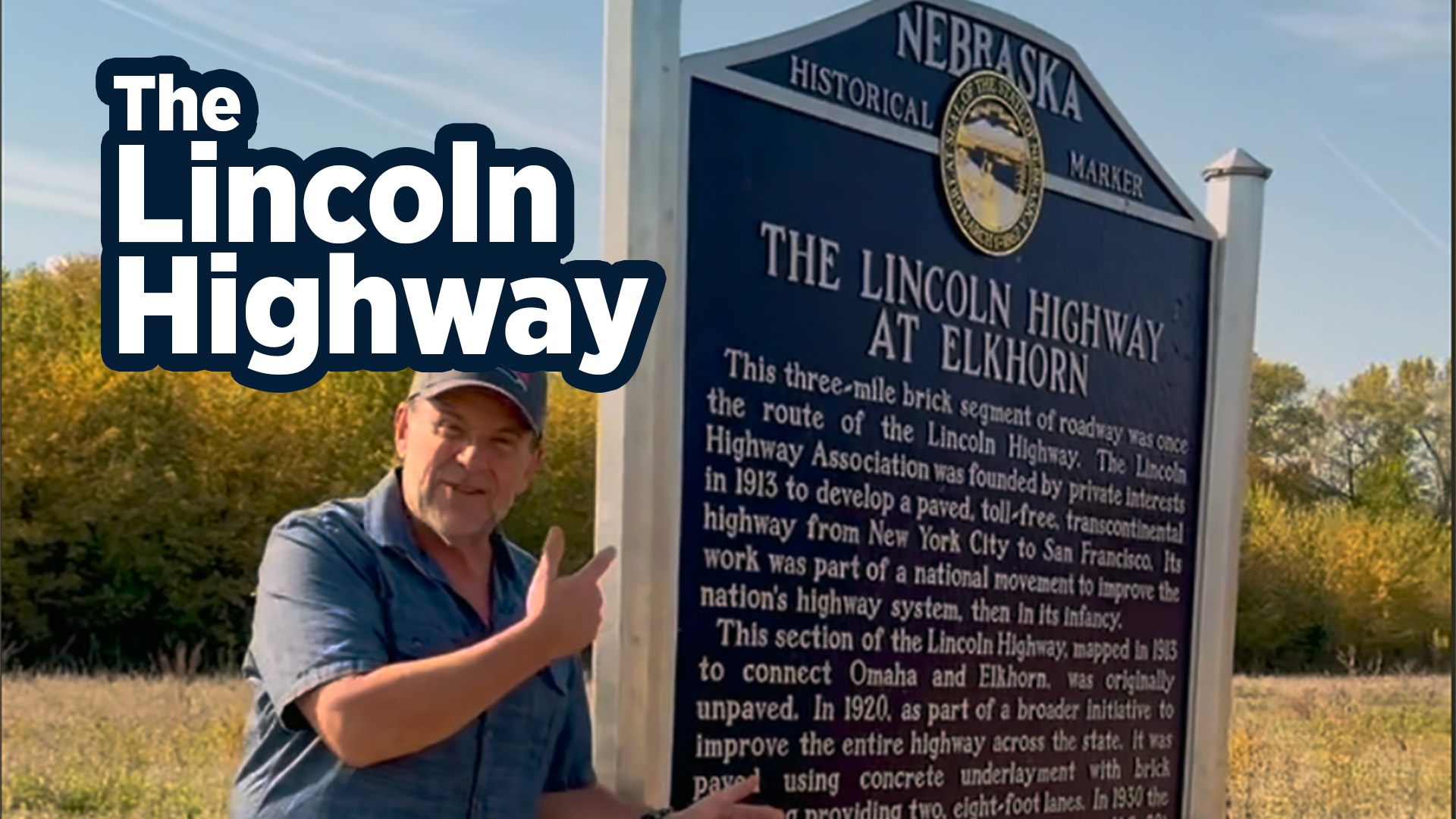
Then last weekend, I drove only about 15 minutes from my home and found something full of interesting transportation history.
The Lincoln Highway reached Omaha in 1913, thirteen years before Route 66 existed at all. And unlike most of the original route, which got paved over, rerouted, or simply forgotten, a three-mile stretch of it near Elkhorn is still exactly what it was in 1920: brick. Real brick, laid by hand, and you can still drive on it.
America's First Highway Comes to Omaha
The Lincoln Highway wasn't the brainchild of a government agency. It came from Carl Fisher, an automobile entrepreneur who figured the whole industry was dead in the water without decent roads to drive on. In 1913 he incorporated the Lincoln Highway Association and laid out a coast-to-coast route from Times Square in New York to Lincoln Park in San Francisco. Through Nebraska, the road followed old overland trails along the Platte River Valley, roughly 450 miles of it.
Omaha got its section on October 31, 1913, and the city celebrated like it mattered, because it did. Automobile dealer H.E. Frederickson lit bonfires. Civic booster Rome Miller gave a speech. In those early years there wasn't even a proper highway sign system yet. The road was marked with red, white, and blue bands painted straight onto telephone poles, a blue letter L stamped in the middle of the white stripe. That was it. That's how you found your way across the country.
Through the Heart of the City
If you'd followed the highway west through Omaha in, say, 1925, you would have crossed the Missouri River on the old Douglas Street Bridge, a toll structure that had been carrying wagons and cars since 1888 (it wasn't torn down until 1968, well after the interstate bridge took over). From there the route angled through downtown along Douglas, jogged south to 18th or 24th, and joined Farnam Street.
Farnam between 18th and 26th was Omaha's "Automobile Row," lined with dealerships, tire shops, and multi-story showrooms. The old Hupmobile dealership building still stands at 2523 Farnam. So does the Blackstone Hotel, which opened in 1916 at 36th and Farnam and hosted plenty of highway travelers looking for a bed.
At 40th Street the route turned north onto Dodge and pushed straight west through Dundee, past the old Saddle Creek Road intersection, the site of John Sutter's Mill, one of the oldest structures in the city, and on toward what would later become Boys Town. Father Edward Flanagan hadn't even established Overlook Farm yet. That came in 1921, a few years after travelers were already rolling past the land on their way out of town.
The Army Convoy That Changed the Interstate System
The most consequential thing to ever happen on this stretch of road probably wasn't a parade or a ribbon cutting. It was a military experiment.
In the summer of 1919, the U.S. War Department sent 81 vehicles rolling across the country from Washington, D.C. to San Francisco, mostly to see whether the Army could actually move trucks over American roads in an emergency. A young lieutenant colonel named Dwight Eisenhower rode along as an official observer. The convoy crossed the Douglas Street Bridge into Omaha on July 29, 1919, and the city basically declared a holiday. Crowds turned out. It was a big deal.
Omaha's paved streets handled the convoy just fine. West of here, it was a different story: mud pits, collapsing wooden bridges, stretches of sand that swallowed truck wheels whole. Eisenhower took detailed notes on all of it. Those notes sat with him for decades, and when he became president, they're a big reason he pushed so hard for the Federal-Aid Highway Act of 1956, the law that built the Interstate System we drive on today. A rough cross-country trip through Nebraska mud helped build the interstate.
The Midnight Sign War
By the late 1920s, the Lincoln Highway had been folded into the federal numbering system as US-30, but Omaha's section had two problems: traffic was choking Dodge Street, and crossing the Missouri still meant paying a private toll on the Douglas Street Bridge.
In 1930, the Abraham Lincoln Memorial Bridge opened across the river up at Blair, Nebraska, toll-free. State officials and highway association leaders saw a chance for a shorter, faster route and took it. That July, road crews moved through Omaha in the middle of the night and pulled down every official Lincoln Highway and US-30 marker in the city, then put them back up along the new route through Blair.
Omaha woke up to a highway that no longer officially existed. The World-Herald and city leaders were furious, threatening lawsuits and calling it an outright theft of tourist commerce. Small towns along the new route weren't exactly sympathetic. The Blair Enterprise ran an editorial basically telling Omaha it had no right to monopolize transcontinental trade.
The reroute stuck anyway. Omaha's old alignment got downgraded to US-30 South for a while before eventually becoming pieces of US-275 and what's now West Dodge Road, US-6.
Three Miles That Should Not Still Be Here
Here's the strange upside of getting bypassed: because Omaha lost its official highway status in 1930, long before the suburban boom of the 1950s and 60s, the stretch of road running from 174th Street to 192nd Street out toward Elkhorn never got widened, rerouted, or buried under a subdivision. It just sat there.
Douglas County laid the brick itself in 1920 and 1921, vitrified brick over a concrete base, built for what was then a rural farm-to-market road. In the early 1980s, county engineers floated the idea of just covering the whole thing in asphalt and calling it a day. Local preservationists pushed back hard enough that the county restored the original brick instead of paving over it. That decision is the only reason any of this exists for me to drive on today.
The road made the National Register of Historic Places in 2003. There's still an active six-ton weight limit on it to protect the brick bed, and it's one of the longest stretches of original Lincoln Highway brick surface left anywhere in the country that you can still legally drive.
What It's Like to Drive It
I pulled onto the brick Sunday afternoon with my camera running. The transition from regular pavement to brick isn't subtle. You feel it in the steering wheel before you see it, a low rumble that doesn't let up for three miles.
About halfway through, the road crosses West Papillion Creek on a reconstructed pony truss bridge that keeps the original grade of the highway intact. I stopped there first. Then I pulled over near the markers closer to Elkhorn, where the Lincoln Highway Diamond Jubilee Committee put up a monument back in 1987, complete with replica 1928-style highway markers and a plaque laying out the history in a few hundred words.
Standing there, it's easy to forget this three-mile strip was once part of a road connecting two oceans. It's quiet now. Railroad tracks run alongside it. Prairie grass grows right up to the edge in places. Cars go by slow, mostly locals who know the brick is there and know enough to respect it.
Go See It Before You Can't
Route 66 gets the museums, the neon, the 100th-anniversary road trips, and it earned every bit of that attention. But the Lincoln Highway got here first, by thirteen years, and most of what made it matter has long since been paved over or forgotten everywhere else in the country.
Not here. Not yet. If you're anywhere near Omaha, take 180th Street north off Dodge, find where the pavement turns to brick, and drive it slow. Read the markers. Feel the rumble in the wheel. It's not every day you get to put your tires on something that's been there for over a hundred years, still doing exactly what it was built to do.